Why Policy Pilots Took Hold in Government
Why policy pilots took hold: learn how bounded trials fit government decisions and how to judge what their findings can—and cannot—support.
A city department is considering a new way to route housing advice. The proposal sounds workable, but staff do not yet know whether referrals will reach the right team or whether residents can use the process. A policy pilot gives officials a bounded way to examine those questions before making a broader choice.
Policy pilots took hold because they fit a recurring institutional problem: governments must act amid uncertainty, yet a full rollout can be hard to reverse. Pilots offer a visible middle course—limited implementation paired with a stated opportunity to learn. Their appeal is not that they settle disputes, but that they give agencies a format for testing administrative arrangements and explaining what they learned.
Institutional pressures
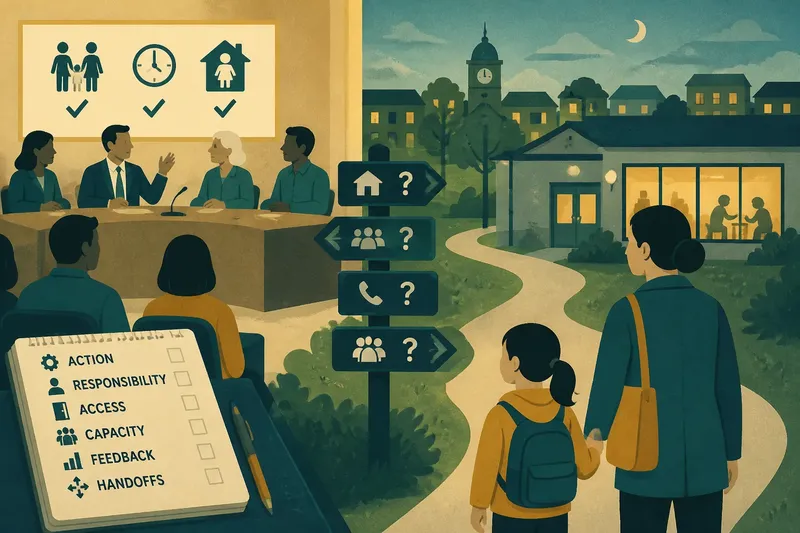
Public agencies are often asked to justify both what a program is meant to do and how it will work in practice. A policy can have a persuasive rationale and still depend on unanswered operational questions: who handles referrals, which records staff need, or what happens when a case does not fit the standard process.
A bounded trial can make those details easier to inspect. It gives managers, frontline workers and participants a shared point of reference: an actual arrangement in a defined setting, rather than a proposal described only on paper. That is particularly useful when several offices or partner organizations must coordinate.
Pilots also offer a politically legible alternative to immediate expansion. Officials can say they are proceeding cautiously, while critics can ask what the trial is meant to establish. That framing can help structure public discussion, though it can also become a reassuring label for a decision that has already been made.
Administrative learning
The spread of pilot programs reflects a change in how public administration talks about implementation. Instead of treating delivery as a final mechanical step, agencies increasingly have reason to examine how rules meet staffing, local procedures and participant needs. The point is not that every policy should be trialled; it is that some uncertainties only become visible in operation.
Evaluation practices helped make limited trials easier to describe and review. Officials could set out the activity, its boundaries and the information they planned to collect, then connect that information to a decision. This gave a pilot a recognizable form that could be discussed across departments and in public debate.
There is a practical appeal, too. When uncertainty concerns workflow or coordination, a bounded attempt may show where a process jams before agencies commit to reproducing it more broadly. It cannot remove the need for judgment, but it can make some assumptions inspectable.
Boundaries and context
A pilot’s limits shape what its findings mean. A trial might cover one service area, a selected group of participants, a few delivery sites or a temporary arrangement. Those boundaries can keep the undertaking manageable, but they also narrow the claims that its evidence can support.
Suppose a pilot relies on a central office with experienced staff and established partner relationships. Its smooth operation would say something about that arrangement; it would not, by itself, settle how the same process would fare in an office with different staffing or referral routes. Context is part of the evidence, not a footnote to it.
For that reason, a clear account should identify who could participate, what service or process changed, what remained in place, and where the trial operated. Without those details, “pilot” can mean little more than a temporary initiative with an attractive name.
What should a pilot record?
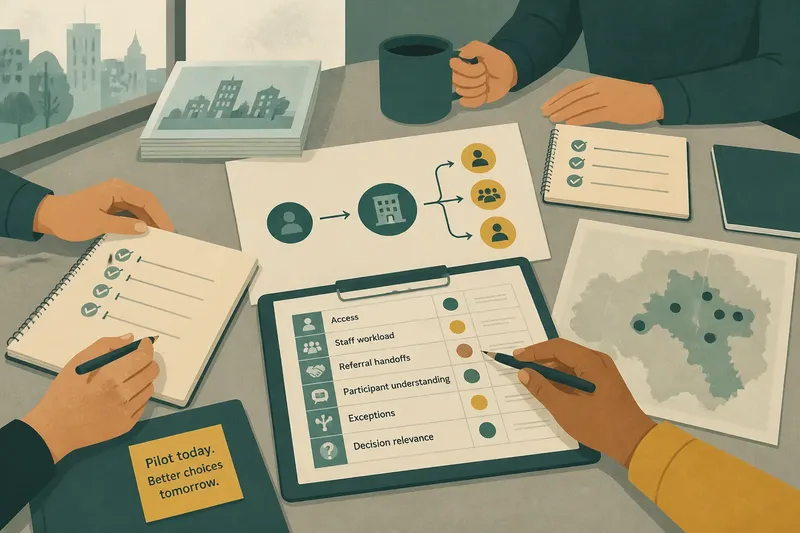
Information is useful when it can affect a decision. The following checks connect observable conditions to a next step rather than treating data collection as an end in itself.
- Participant access: Check whether intended participants can find and enter the service; if access routes are confusing, then revise outreach or intake support, otherwise keep the route under review.
- Staff workload: Check whether staff can complete the process alongside ordinary duties; if essential tasks are routinely delayed, then adjust staffing or simplify the process, otherwise examine whether the arrangement can be maintained.
- Referral handoffs: Check whether partner agencies receive complete referrals; if cases repeatedly stall at a handoff, then clarify responsibilities or change the referral route, otherwise retain the current coordination method.
- Participant understanding: Check whether people understand what happens after enrollment; if they cannot describe the next step, then revise explanations or follow-up, otherwise preserve the materials while monitoring questions.
- Exceptions: Check how staff handle cases that do not fit the standard route; if exceptions have no workable path, then design one before expansion, otherwise document the existing route for comparison.
- Decision relevance: Check whether each record or interview answers a question tied to the next policy choice; if it does not, then stop collecting it or explain its purpose, otherwise retain it in the evaluation plan.
These checks do not turn a pilot into a verdict machine. They make the connection between observation and action visible, which is a more modest and more useful ambition.
Limits of trial evidence
A pilot can clarify whether a process is workable in its setting, what barriers participants encounter, and which parts need adjustment. It can also show whether an agency can collect the information needed for a later evaluation. Those are meaningful findings, even when they do not answer whether the policy changes a broader social outcome.
Limited trials are less suited to broad claims about long-term effects or performance across varied places. Participants may differ from those who would encounter a wider program; local staff and partner arrangements may also be unusual. A promising result should therefore be reported alongside the conditions that produced it.
Nor does a rough start automatically discredit the underlying idea. It may indicate a design problem, a local constraint or missing support. The interpretation depends on what was attempted and what evidence was gathered—not on whether officials can describe the experience as a success.
From findings to choice
A pilot is useful only if its findings connect to a real choice: expand, revise, repeat in another setting, pause or stop. Decision criteria should be stated before results are interpreted, so that the standard does not shift to protect a preferred outcome.
Imagine a county office trying a new appointment process. At the start, staff expect residents to book online, while walk-in assistance remains available. They record whether people complete bookings, ask residents where the instructions become unclear, and note when staff must step in. If residents repeatedly need help at the same point, the office revises the instructions and provides assisted booking before considering another site. The resulting decision is to improve access and examine the process again—not to claim that the system will work across the county.
That distinction matters in public debate. When officials cite a pilot, ask what decision followed and whether the claim matches the setting, participants and evidence. A trial that leads to revision has still done useful work; a trial whose findings cannot change anything may be little more than ceremony.
Questions about pilots?
Are pilots the same as experiments?
No. “Pilot” describes a limited trial of an approach, while “experiment” usually refers to a particular design for comparing conditions or outcomes. A pilot may use an experimental design, but the terms are not interchangeable.
Can a pilot prove a policy works?
A pilot can show how an approach operated in a defined setting and may reveal early signals. Broad claims about effects require evidence suited to that claim, and a limited setting does not automatically represent wider implementation.
Why not expand a promising idea immediately?
A promising result may leave practical questions unresolved, such as staffing, access or coordination. A decision-maker can use a pilot to examine those conditions before deciding whether expansion is sensible.
When is a pilot not worth the effort?
If no plausible finding could change the decision, or the trial cannot produce evidence relevant to the choice, it may add process without useful learning. A direct decision with clear reasons can be more honest than a pilot used mainly to signal caution.
Claims that fit
Policy pilots took hold because they offered governments a recognizable way to combine limited implementation with organized learning. Their strongest contribution is not a promise that small trials predict everything, but a clearer account of what happened under specified conditions and what officials chose to do next.
When reading about a pilot, look for the boundary, the question, the observations and the decision. If any of those are missing, treat claims of wider relevance cautiously. Policy pilots can inform judgment; they cannot make judgment optional.