The Announcement Is Not the Implementation
The announcement is not the implementation: trace a policy from stated intention to formal decision and actual delivery before judging what has changed.
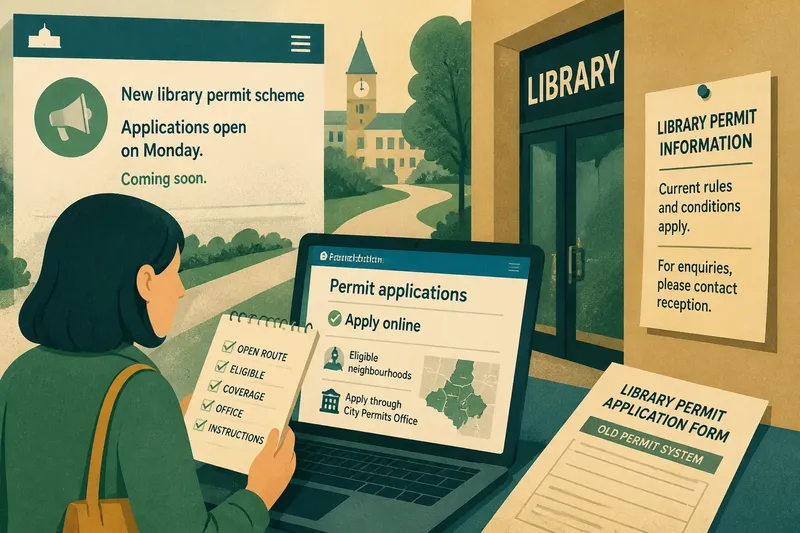
A council website says a new permit scheme is “coming soon,” while the notice pinned beside the library door still lists the old rules. To work out what residents can do today, check the policy’s operating route, not just the announcement. Implementation means the change has reached the people or process it is meant to affect.
Follow the operating route
Start with the person expected to use the policy. That might be a resident applying for a permit, a teacher following revised guidance, or a council officer processing a request. Identify the action they should be able to take and the organisation responsible for making it possible.
Then look for the practical route: a current form, service page, appointment process, staff instruction or public notice. A policy paper can explain the design, but it cannot tell you whether the relevant office is accepting applications. A recruitment notice or procurement record may show preparation; it does not, on its own, show that the route is open.
Keep each piece of evidence tied to what it demonstrates. A live application form supports the claim that people can apply through that channel. It does not establish that every eligible person has been reached, or that requests are being processed promptly. Those are separate claims and need different evidence.
Check the usable evidence
Before saying a policy is in operation, check whether the intended user can take the stated action now. Confirm that the relevant page is current, that its instructions match the form or contact route, and that the service covers the place and people named in your account.
- Current form: If the form accepts the relevant request and matches the published rules, report that this application route is available; if it is a blank template or marked “coming soon,” describe the service as not yet open through that route.
- Eligibility details: If the page identifies who qualifies, state that scope; if the rules are missing or unresolved, say eligibility is unclear rather than assuming everyone can apply.
- Start date: If the effective date has passed and the service is active, describe the change as in force; if the date is future or conditional, say it is scheduled or subject to that condition.
- Responsible office: If a named office handles requests, identify it; if responsibility is split or unstated, explain that users may need to confirm which organisation administers the policy.
- Local coverage: If the source lists the areas included, limit your claim to those places; if it gives no coverage, avoid presenting a local service as a national one.
- Public instructions: If the instructions agree with the current form, treat them as evidence of an available route; if they conflict, report the discrepancy and check with the organisation that runs the service.
Say you are checking a new library permit scheme. The council page says applications open on Monday, its downloadable form still refers to the old permit, and the library notice names no new process. You check the council’s permit page and find that the online form now accepts applications, lists the eligible neighbourhoods and directs applicants to a named council office. The defensible account is that the online route is open for those neighbourhoods; the outdated paper form remains a problem for anyone relying on it. The next useful check is whether the council updates that form, not whether another announcement repeats the launch date.
Not every preparatory detail merits a search. Internal meeting notes and routine staffing updates rarely clarify what a resident can do. Prioritise records that establish who operates the route, what action is available and where it applies.
Separate access from results
An open route is evidence of access, not proof of the policy’s broader effect. A service can accept applications while decisions remain pending; a revised rule can take effect while staff and users are still adjusting to it. Describe the observable stage and leave claims about outcomes to evidence that addresses outcomes.
For local policies, use the council or agency responsible for the relevant area. National coverage may describe the policy’s general design while leaving local administration to individual bodies. If the source does not establish which places are covered, make that uncertainty explicit instead of extending the claim by implication.
Which evidence answers what?
Does a public notice show that a service is open?
Only if it gives a current way to act, such as a working application channel or a usable contact process. A notice announcing a future opening date shows preparation or a planned start, not current access.
What if the form and guidance conflict?
Record both documents, compare their dates and identify which organisation maintains the service. If the conflict remains, report it and direct readers to the responsible office for clarification rather than choosing the more convenient version.
Can one open route represent the whole policy?
Not necessarily. A route may cover only certain locations, users or types of request, so name those limits whenever the source gives them.
Describe the current state
Write an account that names the operating organisation, the action available, the people or places covered and the evidence supporting each detail. If one of those parts is unknown, narrow the claim. “The council’s online permit form is open to residents of the listed neighbourhoods” is more useful than saying the scheme has been rolled out everywhere.
Keep the original announcement as evidence of what was promised, then return to the operating route when the policy changes. A revised form, updated instructions or a new coverage notice can show what users can do now. The smallest useful question is often the plainest one: which page, office or procedure would a person actually use?