Consultation and Deliberation Do Different Jobs
Consultation and deliberation serve different public decisions. Learn what each can reveal, who should take part, and how to choose a fair process.
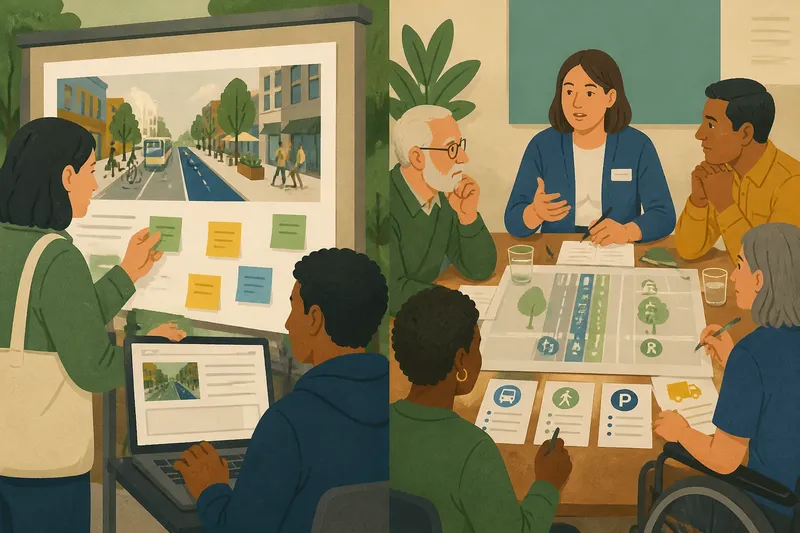
A city posts a draft street redesign online and asks residents to comment. A week later, a smaller group meets to compare options for the same block, including what each would mean for buses, parking, walking and deliveries. Both activities invite public input. They do not ask people to do the same job. Consultation gathers views on a proposal; deliberation gives participants time and structure to weigh options together.
That distinction matters before a public body picks a format, writes an invitation or announces that “the public was consulted.” Consultation is suited to hearing reactions, experiences and objections, often from a broad set of people. Deliberation is suited to examining trade-offs that require information, discussion and considered judgment. Neither method makes a decision on its own. The useful question is what kind of input the decision still needs.
Two distinct purposes
A consultation usually begins with an identifiable policy, draft or decision under consideration. Officials ask people to respond to it: What works? What is missing? Who may be affected? What alternatives should be considered? Responses may arrive through written submissions, public meetings, surveys, workshops or conversations with affected groups.
Consultation can be open to anyone or targeted to people with relevant experience. Its breadth is an advantage when a decision-maker needs to hear from dispersed communities, organizations, service users or professionals. It can surface local knowledge that a central policy team would not otherwise see, including practical barriers and unintended effects.
But responses are not a representative sample merely because an invitation was public. People who have time, confidence, access to the process or a strong view may be more likely to take part. A consultation can still be useful; the limits lie in treating the volume or tone of responses as a direct measure of what the whole public thinks.
Deliberation asks a different question: after considering relevant information and hearing competing reasons, what judgment do participants reach? Participants receive time to understand the issue, ask questions, discuss evidence and weigh options. A facilitator helps keep the exchange focused and makes room for disagreement, rather than turning the meeting into a sequence of speeches.
A deliberative process may use a citizens’ assembly, a citizens’ jury or another structured group. These formats differ, but they share a commitment to informed discussion rather than simply collecting initial reactions. A group may be recruited to reflect a range of public characteristics, but its conclusions are not automatically the view of every resident. Its value is in the reasoning participants can develop together.
What each can reveal
Consultation is particularly useful when officials need to identify impacts, test the clarity of a proposal or learn how a service works in practice. A tenant describing how a proposed application process interacts with shift work can reveal a design problem. A local business may point out delivery needs that a broad policy paper has overlooked. These contributions can help revise a proposal before it is settled.
Deliberation is better suited to questions in which choices compete and no option satisfies every concern. Participants may need to compare access with cost, convenience with privacy, or a near-term benefit with a longer-term burden. Structured discussion gives them a chance to hear why others weigh those considerations differently. The result can clarify which trade-offs people consider acceptable and what conditions might make a choice fairer.
That does not mean deliberation produces consensus. Participants may finish with a shared recommendation, several distinct views or a clear account of unresolved disagreement. A process that records minority reasoning can be more honest than one that presses for a tidy common position.
Consultation and deliberation can also inform one another without being collapsed into a single event. Broad consultation may reveal which issues deserve close examination; deliberation may then help participants weigh those issues. A later consultation can invite comment on a revised proposal. The sequence is useful only if decision-makers explain what each stage can influence.
Choosing participants
For consultation, the central design question is whose knowledge or experience is needed, and how they can contribute without unnecessary barriers. An open call can gather a wide variety of responses, while targeted outreach can reach people who are easily missed by standard channels. Plain-language materials, accessible meeting formats and options for written or spoken input make participation more practical.
For deliberation, recruitment and support carry more weight because participants are expected to learn and reason together. Organizers need to consider who is invited, how relevant information is presented, whether participants can ask independent questions, and whether facilitation allows different voices to be heard. Time, travel, childcare, interpretation or other participation needs may shape who can attend; ignoring them can narrow the discussion before it begins.
Neither format should ask people to contribute under a false impression of authority. Participants need to know whether their role is advisory, whether officials have already ruled out certain options and who will make the final decision. If a legal duty, institutional mandate or fixed constraint limits the choices, state that plainly. A room full of people cannot deliberate an option that was never available.
Design around the decision
Start by writing down the decision that remains open. If officials need comments on a nearly complete draft, consultation may be the clearer fit. If they have several plausible options and want informed public judgment about their trade-offs, deliberation may be more suitable. If both needs are real, separate the tasks and explain the connection between them.
Say you are helping a county decide how to allocate limited space on a busy main street. The initial proposal would widen sidewalks, but would also change loading access. You could invite businesses, residents, transit users and people with mobility needs to describe effects and identify omissions through consultation. If officials then need to weigh competing street-use options, a recruited group could study maps and operational information, hear different perspectives and deliberate on the choices. The observable result to look for is not universal agreement: it is a clearer record of local impacts from consultation and reasoned judgments about trade-offs from deliberation.
Before choosing, ask:
- What is open to change? If the proposal is fixed, explain what feedback can still affect; do not stage deliberation over a settled choice.
- What kind of answer is needed? Use consultation for experiences, reactions and missing information; use deliberation for considered judgments among competing options.
- Who has relevant knowledge or is affected? Plan outreach and recruitment around those people, rather than assuming a public notice reaches everyone.
- What support will participation require? Provide clear materials, accessible ways to contribute and enough information for the task.
- How will the input reach a decision? Name who will review it, when they will respond and how it may shape the choice.
- How will disagreement be recorded? Preserve important differences rather than reducing every response to a single headline.
It is not worth engineering a complicated deliberative process when a focused request for local experience will answer the question. Nor is a brief comment period a substitute for deliberation when officials need people to weigh difficult alternatives. More formal is not automatically more meaningful; the match between task and method does the real work.
Make the response visible
Public input becomes credible when people can see how it was handled. For consultation, report the main themes, note where views differed and explain which issues changed the proposal or prompted further work. Avoid presenting a stack of submissions as though every response carried the same argument or represented the same constituency.
For deliberation, publish the question participants considered, the information they received, the recommendations or areas of disagreement, and the decision-maker’s response. If officials reject a recommendation, they should explain why. If they accept it only in part, identify what was retained and what was not. A response does not have to satisfy participants to be intelligible.
This follow-through also improves the next process. People can judge whether participation was useful, and officials can see whether they asked a question that the method could answer. The choice between consultation and deliberation is therefore not a contest over which sounds more democratic. Consultation helps a decision-maker hear what people know and think about a proposal; deliberation helps a group reason through what should be done when the options pull in different directions.