Reading a Policy Document for Its Decision Points
Reading a policy document for its decision points helps you identify who can authorize a proposal, what evidence or conditions apply, and what remains open.
You open a council paper expecting a decision and find a recommendation, a draft timetable, and a note that approval is still required. Reading a policy document for its decision points means tracing how an institution moves from a proposal to an authorized choice—not sorting the proposal’s aims from its tools.
The useful questions are procedural: who can decide, what must they consider, which approvals or conditions apply, and what record will show the outcome? Those details are often scattered across a cover sheet, a recommendation, a delegation rule, and a closing section. A small decision log helps keep them together.
Find the decision request
Start with the cover page, executive summary, or section headed “Decision,” “Approval,” or “Recommendations.” Identify the exact action requested: approve a plan, authorize consultation, select an option, or note a report. These verbs matter. “Note” may ask decision-makers to acknowledge information; it does not necessarily ask them to authorize the proposal described in the same paper.
Record the requested action in the document’s own terms, then check whether the paper calls it a recommendation, a proposed resolution, or a decision already taken. A report recommending that an agency adopt a new procedure is not itself evidence that the agency has adopted it.
Trace authority
Look for the person or body authorized to make the choice. A department may prepare a recommendation, a minister may approve it, and a committee may have authority over a related detail. Do not assume that the author, presenter, or most senior person named in a paper has the relevant power.
Check references to standing orders, delegation instruments, statutes, board rules, or internal approval routes. If the document names an approving body but does not identify the basis for its authority, note that gap rather than supplying a legal interpretation. For a consequential question about legal powers, consult a qualified professional or the institution’s official guidance.
Follow conditions
A proposed action may depend on another approval, a consultation, a budget decision, or a finding that a stated condition has been met. Search for phrases such as “subject to,” “following approval,” “provided that,” and “before implementation.” Write each condition beside the decision it qualifies.
Distinguish a condition that blocks authorization from a task that follows authorization. If a committee must approve a plan before staff can issue guidance, committee approval is a decision point; drafting the guidance may be an implementation task. The document’s sequence and wording usually reveal which comes first.
Track the decision record
Find out how the outcome will be recorded: formal minutes, a signed decision notice, a published resolution, or a revised policy document. Then check whether the paper identifies when that record will be made available and who is responsible for it. If those details are absent, write “not stated.” A confident recommendation is not a substitute for a record of approval.
Record the status at the time you read the paper. Useful labels include “requested,” “recommended,” “approved,” “deferred,” and “rejected,” but use them only when the text supports them. If the paper says a decision is expected at a later meeting, the status is pending even if the preferred option is described at length.
What should I check?
Who has authority to decide?
Look for the named decision-maker and the rule or delegation that gives them authority. If the document names no authorized person or body, record the gap and seek the institution’s formal procedure rather than guessing.
Is the request approval or advice?
Read the operative verb in the requested resolution and compare it with the paper’s status language. If the request is only to note or discuss the report, do not describe the proposal as approved.
What must happen before a decision?
Search for approvals, consultations, conditions, or required findings that precede the choice. If a prerequisite remains open, mark the decision as conditional or pending, as the document indicates.
Where will the outcome appear?
Look for the stated record, such as minutes or a decision notice, and any named publication route. If no record is specified, note that and check the institution’s published meeting or decision procedures.
Keep a usable log
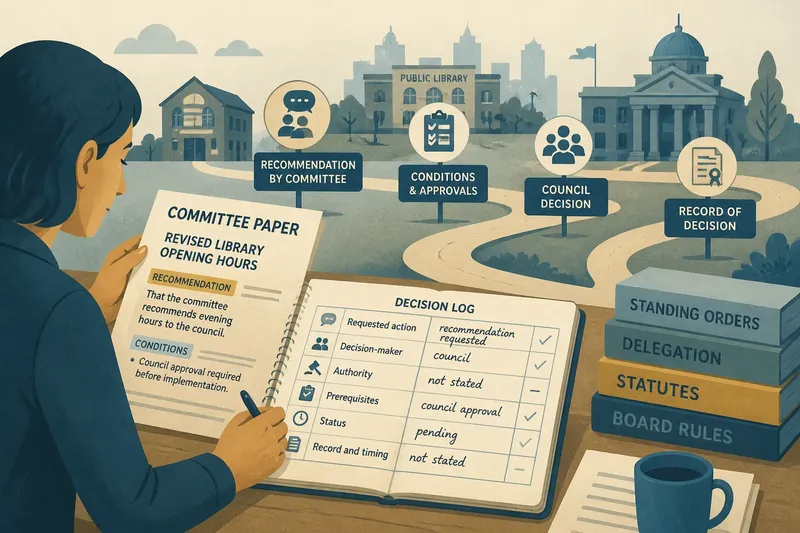
A decision log can be brief. Use one row per requested or pending choice, with these fields:
- Requested action: Observe whether the paper asks for approval, a recommendation, discussion, or acknowledgment; if the verb is unclear, quote it and mark the request as ambiguous rather than classifying it.
- Decision-maker: Observe whether a named person or body is identified; if none is named, record “not stated” and check the institution’s formal procedure.
- Authority: Observe whether a rule, delegation, or legal basis is cited; if one is missing, record the gap and avoid asserting who has power.
- Prerequisites: Observe any approval, consultation, or condition attached to the choice; if it is unmet, mark the decision pending or conditional, and identify what must happen next.
- Status: Observe whether the text says requested, recommended, approved, deferred, or rejected; if sections conflict, preserve both statements and check the formal record.
- Record and timing: Observe whether minutes, a notice, or another record and a timing cue are specified; if either is absent, note “not stated” and consult the institution’s published process.
Say you are reading an invented city committee paper about revised library opening hours. The cover asks the committee to recommend evening hours to the council, and the report says the council must approve the final schedule. You enter “recommendation requested” as the committee’s action, “council” as the final decision-maker, and “council approval” as a prerequisite to the schedule taking effect. The resulting answer is that the committee has not approved the final hours; its recommendation is one stage in a longer route. If the paper does not say when the council will act or where its resolution will appear, both fields remain “not stated.”
Read conflicting signals
A summary may call an option the preferred approach while a later section says authorization is pending. Keep both facts in the log: the proposal has a stated preference, and the formal decision remains open. Likewise, distinguish a stakeholder’s request, an official’s recommendation, and an institution’s recorded decision. The speaker and the procedural status are part of the evidence.
If the paper is vague, do not fill in the blanks from customary practice. Mark what is explicit, what is inferred, and what is absent. What is not worth the effort is highlighting every sentence: focus on passages that establish the requested action, authority, conditions, status, or record.
Reading a policy document for its decision points is most useful when it lets you describe the route to authorization precisely: what action is requested, who can take it, what remains conditional, and where the outcome should be recorded. When an essential authority or condition is unclear, the sound answer is not a guess; it is a clearly marked question for the institution responsible.